
Dementia Care
Dementia care at home, early stage to late
She has asked you the same question four times this hour and the afternoons have started coming apart. Dementia care is non-medical support at home from somebody trained to redirect rather than correct, through early, mid and late stage, including vascular dementia, Lewy body dementia and Huntington’s. Praise Homecare Inc is licensed by North Carolina for in-home aide and for companion, sitter and respite work, and (877) 652-2907 reaches a person at any hour of any day.
A shift, start to finish
One Wednesday, two o’clock to half past five
Rather than describe the service, here is an afternoon of it in a house in eastern North Carolina. Three and a half hours is a common shape. The clock moves to fit your week.
-
2:00
Same door, same greeting, coat on the same hook
The first two minutes set the next three hours, so they get their own time. Nothing is asked of her before she has worked out who this is, and she is not tested on it.
-
2:30
Something with hands in it
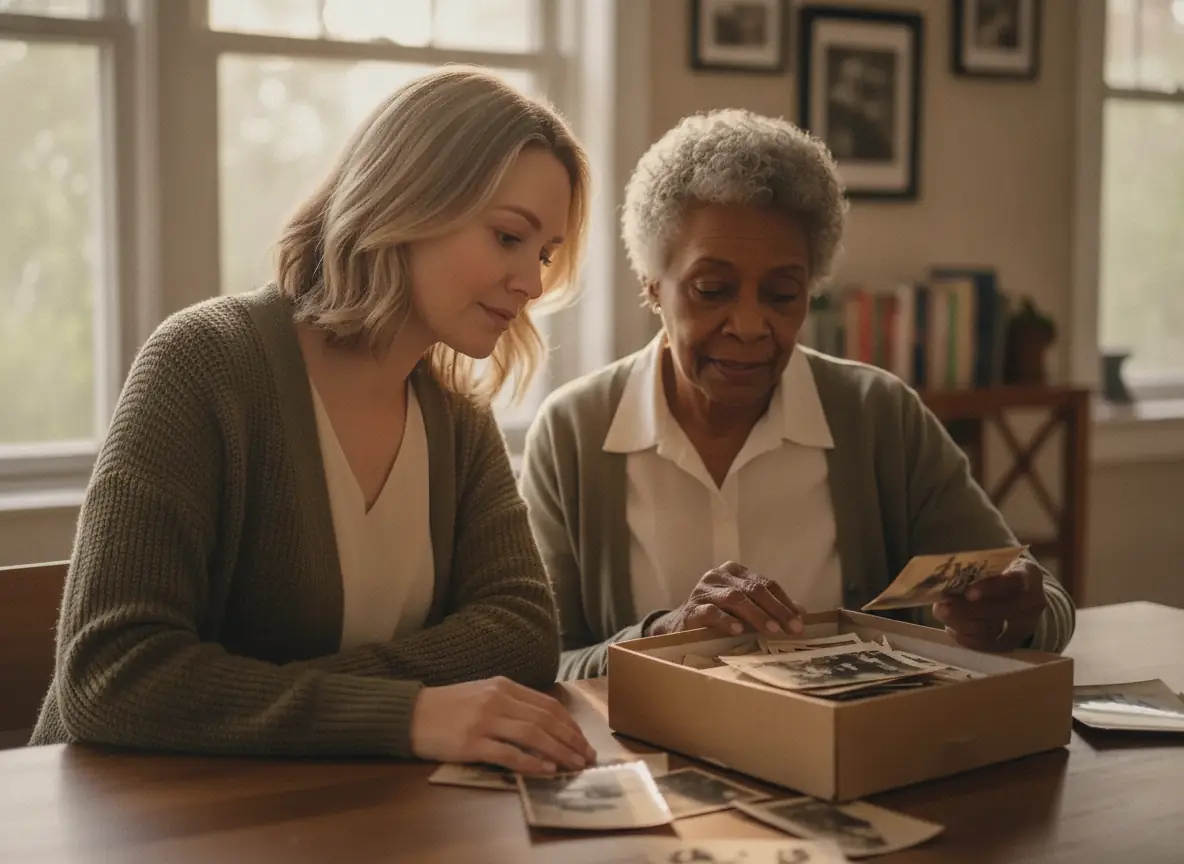
Folding towels, shelling beans, sorting the photograph box. Work she recognises and that has no wrong answer anywhere in it. This is the hour when most of the talking happens.
-
4:00
The restless hour, met early
Curtains drawn before the light goes rather than after, lamps on, radio instead of television, and a walk to the end of the drive if she wants to leave. Wanting to leave is reasonable. Being told she cannot is what turns it into an argument.
-
5:00
Supper cooked in front of her
Eaten together at the table, not handed over on a tray. Smell and noise do more for an appetite at this stage than anything on the plate does.
-
5:30
Handover, out loud and on paper
To whoever comes next, family or caregiver: what she ate, what she asked for, what unsettled her, what settled her again.
Why that shape
Familiar beats clever, every time
Dementia takes away the ability to predict what happens next. Almost everything a good caregiver does is an attempt to give some of that back. The same face where we can arrange it. The same order of events. The chair where it has always been, the mug in the cupboard it lives in, the front door locked the same way each night.
Redirection instead of correction is the other half. Telling her again that her husband died years ago costs her the grief a second time and costs you the rest of the afternoon. Stepping sideways into the farm she grew up on costs the day nothing. It is a trained skill, and caregivers get better at it.
Personal care folds in where it is needed, offered so a choice stays in her hands. Two shirts held up, one in each hand. Medication reminders land at the same hour in the same words from a face she knows, which is often the difference between a tablet taken and a tablet argued over. Reminders only, not administration, and you hear from us the first time one is refused.
Wilson County is home. The same care runs in Nash County and in Greene County, and in seven more besides, and the drive is our problem rather than yours.
Paperwork you actually get
A note left on the table
Every dementia shift ends with one. It exists so the next caregiver starts where the last one finished, and so nobody in the family is the last to find out that Thursdays have got harder. Roughly what one looks like:
Wednesday, 2:00 to 5:30
Ate half a bowl of soup at two, all of her supper at five.
Asked for her mother four times, all of it between half three and half four.
Settled by the photograph box, the radio, and going outside.
Unsettled by the vacuum, and by me leaving the room without saying where I was going.
Reminded about the two o’clock tablets, taken without fuss. Reminders only, not administration.
For tomorrow: curtains before four, not after.
Alongside the notes there are family check-ins, so somebody who is not in the house every day still knows what the pattern is doing. If you want the fuller version of how caregivers are checked, trained and supervised, that lives on its own page rather than being repeated on this one.

Asked on dementia calls
Three that come up almost every time
- She does not think anything is wrong. How does a stranger get in the door?
- Slowly, and not as a caregiver. Early visits are usually introduced as company, or as help with the house, and an introduction before the first shift means the first meeting can be a cup of tea rather than a bath.
- Is this different from your Alzheimer’s care?
- The craft is the same. The arc is not. Alzheimer’s tends to move in recognisable stages, so that page is organised around them, while this page covers dementia more broadly, including vascular dementia, Lewy body dementia and Huntington’s, where the pattern is less predictable.
- She is awake and dressed at four in the morning. Can somebody be there then?
- Yes. Overnight and around the clock are both available, including weekends and holidays, and four in the morning is a normal thing for us to be told about rather than an unusual one.
A first conversation
Tell us what four o’clock is like
Which hours come apart, what sets her off, what settles her again, and how long you have been holding it together on your own. That conversation is free, it takes about twenty minutes, and it does not commit you to anything. Call (877) 652-2907 whenever you are able to talk, including the middle of the night, which is when a lot of these calls actually happen.