
Let’s Get Social Care
Let’s Get Social Care, keeping her in the family
Practical help staying in touch with people who are not in the room: video calls that actually connect, photographs that arrive, messages answered, and the devices that keep updating themselves and losing her. Praise Homecare Inc runs this as a service in its own right rather than as something squeezed into the end of another shift, and (877) 652-2907 is the number for it, at whatever hour it happens to be where you are.
Written to the one who moved away
Half of this service happens in your house, not hers
You took the job in Charlotte, or Atlanta, or somewhere with a time difference. You call on Sundays. The calls have got shorter, and you have started to notice that you come off them knowing less than you did a year ago, because she says everything is fine and there is no way for you to see whether it is.
That is the actual problem this service solves, and it is a problem that lives at your end of the line. She is not lonely for a screen. She is lonely for her grandchildren, and you are anxious in a way that no amount of phoning fixes, because a phone call is a report and what you want is a look at her.
So this is arranged by the family member who lives away more often than by anybody else, and it is one of the few things you can buy from three hundred miles that makes a genuine difference the same week.
Two houses, one hour
One Sunday call, seen from both ends
Same hour, two rooms, and the reason the service is built around a scheduled shift rather than around a device.
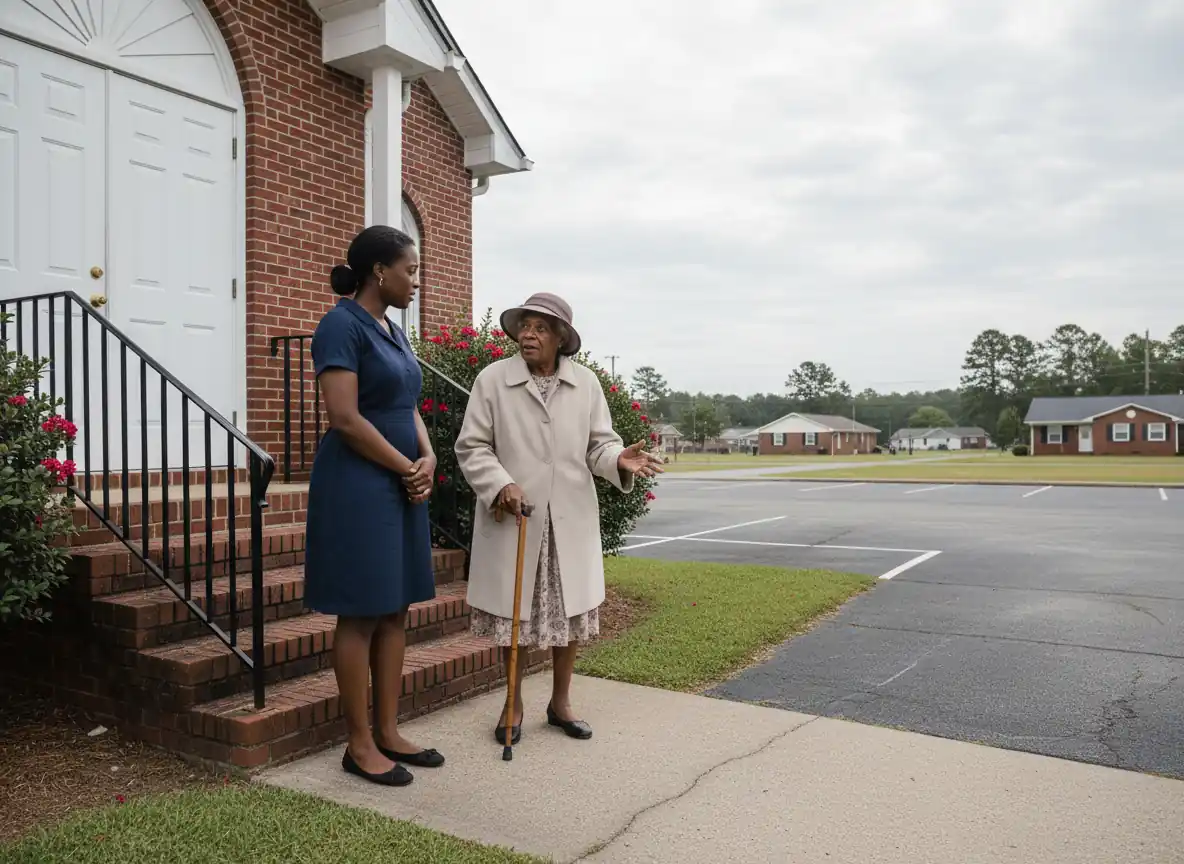
Somebody is there before it rings
The caregiver arrives half an hour early. Tablet charged, propped where the light is behind her rather than in front, sound turned up, the call answered on the first try instead of the fourth.
Then she steps out of frame and gets on with the laundry, because a grandchild talking to a grandmother does not need an audience. She comes back at the end to say goodbye and to hear who is coming at Easter.
You get twenty minutes and a real look
The children come and go from the screen the way children do. Your mother is in her own kitchen, in a good chair, on a call that did not need forty seconds of shouting to establish that she cannot hear you.
You come off it having seen her face rather than heard her voice, and knowing what next Sunday looks like without having to arrange it again from scratch.
Devices and boundaries
Set up by us, owned by her
Facebook, Instagram, FaceTime and WhatsApp are the four that come up most, and all four move under her, not us. A caregiver keeps the thing working and stays out of everything else.
-
Charged, updated and where she left it
Half of these calls fail on a flat battery or an update that moved the icon. Somebody checking it twice a week removes most of that, permanently.
-
Passwords written on paper, in her drawer
Not in ours. Written down, in her handwriting where possible, in a place she chooses. She should never be locked out of her own account because the only person who knew the password was on shift.
-
Nothing posted or read on her behalf
Caregivers do not post as her, do not reply as her, and do not read her messages. Holding a tablet steady is help. Speaking for somebody is not, and the difference matters more the frailer she gets.
-
A caregiver who will teach it twice
And a third time, without sighing. Most people give up on teaching a parent a device because they cannot keep their patience for the fourth repetition. A caregiver can, and it is a large part of what you are paying for.
The unglamorous half
Photographs do more than video calls do
Video is what families ask for. Photographs are what change the week. A picture of the great-grandchild in a school uniform, printed and stuck on the fridge, gets looked at forty times. A call gets looked at once, and it is over.
So a caregiver on this service prints things. Checks the family group for new pictures, prints the good ones, writes on the back who is in them and when. That last part matters later, and families who have been through dementia in the house already know why.
The same shift covers the other correspondence nobody else picks up: the birthday cards that need posting, the reply to the cousin in Virginia, the church newsletter she wants to stay on the list for.
A good many of our families have a son or daughter down in Wake County or Durham County, an hour or two away rather than a flight, and this service works just as well at that distance. An hour is far enough to miss things.
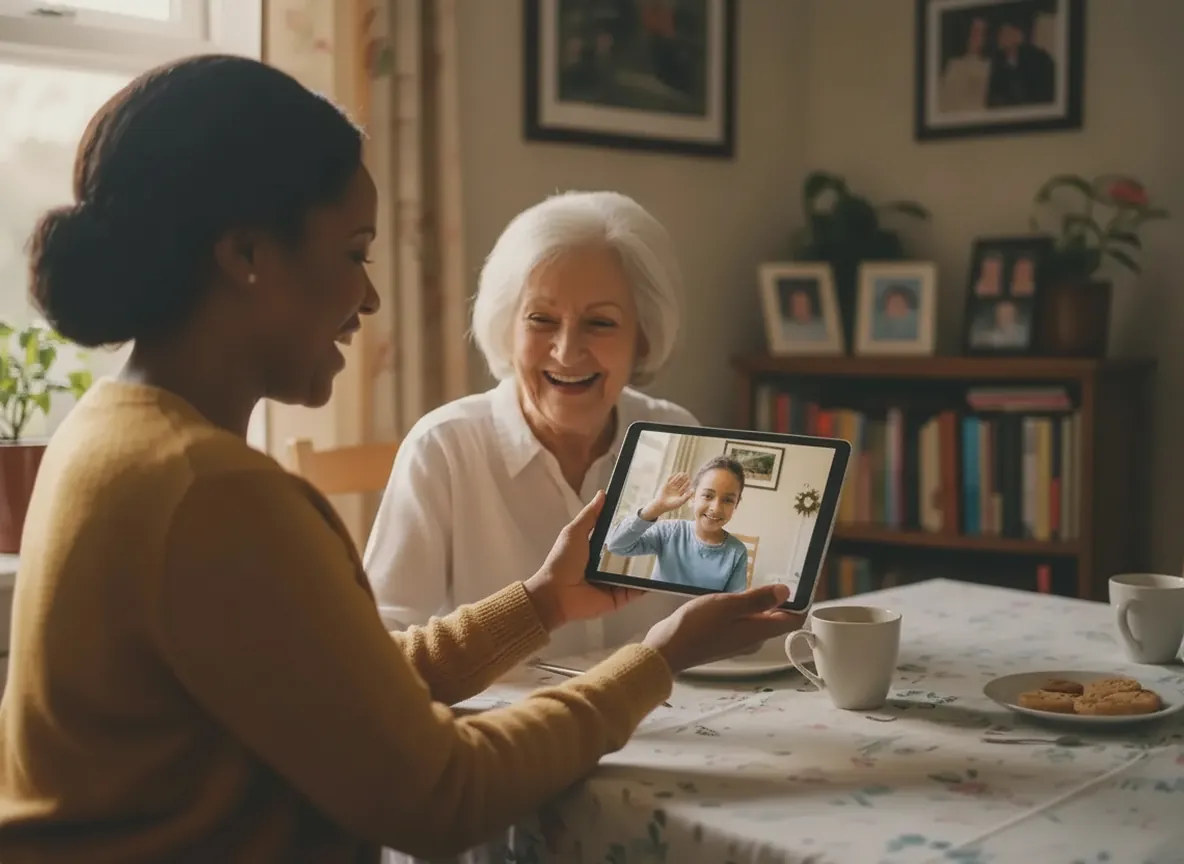
From wherever you are
Arrange it from your own kitchen table
You do not have to be in North Carolina to set this up, and you do not have to have talked your mother into it first. Tell us who she is, who she is missing, and which day of the week the call should be. The assessment happens at her house, and you can join it by phone from wherever you live. It costs nothing, and it commits you to nothing. Call (877) 652-2907 at any hour, in any time zone.